Featured photo by Diego Delso, delso.photo, License CC-BY-SA
We have previously published this co-authored piece, Seeing the NAZCA through new eyes, that I wrote with my writing colleague, Marianne Schmidt, on the following link: https://starburstwisdom.wordpress.com/2019/12/24/seeing-the-nazca-through-new-eyes//
For ease of access, we have now decided to also reproduce the post below.
Seeing the NAZCA through new eyes
Philip Jamieson and Marianne Schmidt
Long associated with the famous but enigmatic Nazca Lines, the Nazca culture justifiably fascinates the public mind. The Nazca emerged on the southern coast of present-day Peru around 200 BCE and survived until ca. 750CE. It is believed that while other pre-Incan cultures (such as the Chavin and Paracas) also created some of the Lines, the majority were the work of the Nazca culture. The Lines are a collection of more than 2000 so far identified giant geoglyphs (ground-produced designs and drawings) located on the Peruvian coastal plain and depicting hundreds of straight lines, as well as various geometric designs and pictorial representations. A research team from Yamagata University in Japan has recently reported identifying another 143 such geoglyphs, thought to have been created at least as early as 100BCE to 300CE.
Somewhat unusually for Nazca geoglyphs, they depict humanoids, as well as many different animals (such as birds, monkeys, fish, snakes, foxes, felines, and camelids). Most significantly, the team announced the discovery of one of these geoglyphs through the use of sophisticated IBM artificial intelligence (AI) technology, employing its capacity to analyze large and complex data sets much more swiftly and efficiently than is possible with the human eye, an application of AI that holds significant promise .
It is this AI-identified geoglyph that has particularly caught our attention.
Unfortunately we have not been able to obtain permission to reproduce the image but it may be accessed on the following link:
https://www.yamagata-u.ac.jp/en/files/7615/7381/2393/PRESS_RELEASE_nasca191115EN.pdf
The image is of a humanoid. This is immediately of interest for, as we have noted, humanoid imagery is relatively uncommon amongst the numerous geoglyphs that have been found. In considering the image, Mariannne has received a number of insights about its form and purpose. We offer these to readers for their consideration. We not do so from the perspective of professional archaeologists and scientists, but as “outsiders” who share with those professionals a deep interest in human history and evolution. We hope to demonstrate a process whereby the figure’s meaning may potentially be discerned through an understanding of ancient mythology, spiritual principles and intuitive insights. We believe that considering these perspectives in conjunction with more traditional archaeological and scientific analyses is the process most likely to lead to closer understanding of the “truth”. To that end, we proffer Marianne’s perspective as one that may add to the debate in understanding these perplexing creations. People are of course free to take our insights, thoughts and analysis on board, or not, as they wish.
There has been much written and disputed about the purpose of the Nazca geoglyphs, and indeed it seems clear that there may well be different purposes in their creation, depending on both when they were created and the form they took. We believe that this particular AI-identified image has a deeply spiritual, religious significance that may well lend support to the theses of those who have identified a similar theme in their interpretation of the geoglyphs. Equally, our interpretation adds a dimension that we are not aware has been previously advanced. While we believe that the geoglyph was created to convey a spiritual lesson, we believe that it may have concerned not only the Nasca, but also a neighbouring culture, the Tiwanaku.
The AI-identified humanoid figure
The figure is relatively small by the standards of the Nazca geoglyphs, only around 4 metres long and 2 metres wide. It is a frontal depiction of a standing humanoid, waving what appears to be a club in its right hand. It has a diminished left leg, no apparent left arm, three “eyes” on its face and a block-like head. There are also three protrusions extending from the top of its head, all of similar length but different width. It has been created by removing the black stones that cover the landscape to form a solid-coloured surface of the white sand beneath, a technique which helps in identifying its probable age as according to the study it was a technique employed in creating geoglyphs dating to the period ca. 100BCE – 100CE, if not earlier.
As with the AI-identified humanoid, figures identified from this period by the Japanese study tend be relatively smaller, with most less than 50 meters across. They were also created beside paths (as in the case of the AI-identified humanoid) or on sloping inclines and are believed to have likely been used as some sort of waypost for travellers, designed more to be looked at than as a location itself for practising rituals. To our minds, ancient “billboards”. But if billboards, “advertising” what?
The role of shamans
We believe that the answer to the question of the message intended to be conveyed by these geoglyphs lies in understanding the role of shamans in Nazca culture. Professor Donald Proulx of the University of Massachusetts has commented that the Nazca religion was based on an active, sacred relationship between humans and nature, with spiritual forces shaping the human condition and shamans acting as intermediaries between these forces and the everyday world.
The Japanese study also identified a second type of geoglyph, generally larger in scale and created later, likely in the period ca. 100 CE to 300 CE. It seems clear that shamans likely played a very significant role at least in relation to these geoglyphs. Given they are believed to have been animal-shaped ritual places, shamans would almost certainly have played central roles in the ceremonies practised at these sites.
It is also interesting that it appears from the Japanese study that these ceremonies involved the destruction of pottery vessels. The creation of humans from clay is a recurring “creation” theme in various ancient cultures and religions (for example, in Christianity God formed a man from the dust of the ground: Genesis 2:7). Marianne has suggested that consistent with this theme, humans might readily be perceived ritually as clay pots or vessels, and their ritual destruction in these ceremonies an attempt to invoke the destruction of those groups of humans ritually represented or, less likely, a ritual re-enactment of such a destruction that has occurred in the past.
In any event, it seems reasonable to assume that given the very likely role shamans played in the rituals performed at the sites of the later geoglyphs (identified in the Japanese study) that shamans also very likely had similarly important roles in relation to the earlier “billboard” geoglyphs. The question is what exactly was that role?
In an illuminating paper considering how total solar eclipses may have inspired the Nazca lines and geoglyphs, Robin Edgar has suggested that the geoglyphs “served not only as an impressive offering of art honouring [the Nazca] gods but very possibly were even intended to be ‘signals’ to these … gods in an effort to communicate with them”. Our view is not dissimilar, but for us the “billboard’ geoglyphs identified in the Japanese study (the AI-identified humanoid amongst them) served not so much as messages to the gods as messages from them. And in Marianne’s insights it is the shamans who received these spiritual messages and reflected them in the geoglyphs.
The significance of eclipses
In illuminating this shamanic role, we were fortunate to have available to us Edgar’s analysis of the possible role of eclipses in Nazca spiritual life generally. He notes there to have been an extraordinarily high incidence of solar eclipses in the region of southern Peru during the period of the Nazca civilisation, with several coinciding with the construction of the geoglyphs we are considering here, most likely created on the Nazca plateau around 100BCE to 100CE. He believes these eclipses would have had a profound effect on the Nazca, and in particular we would suggest upon their shamans, conduits of the spirit world interpreting the gods’ messages and wishes.
Many ancient cultures believed that the sun and the moon were sky dwelling gods. The relationship between the two was predictable, patterned and understood. But an eclipse changed, and challenged, that relationship, visually and energetically. A full solar eclipse in particular would have been a terrifying event to the local population who would have been thrown into an unnatural darkness. For the Nazca, as for other ancient civilisations, this would have represented a challenge to the natural order, a portent of coming destructive change, potentially even “the end of the world”. Given their fears, we could expect people to look to their shamans to guide them through these dark and terrifying times. These were people who could “see in the dark” by reading energies beyond the visible spectrum of light. It is no surprise, then, that the humanoid figure we are examining includes what appears to be the ‘third eye’ of intuitive insight. It is also noteworthy that the head of another Nazca humanoid figure identified prior to this recent Japanese study is dominated by two enormous eyes (and for this reason sometimes called “the Owlman”), a person with supernatural vision – in our view, a shaman.
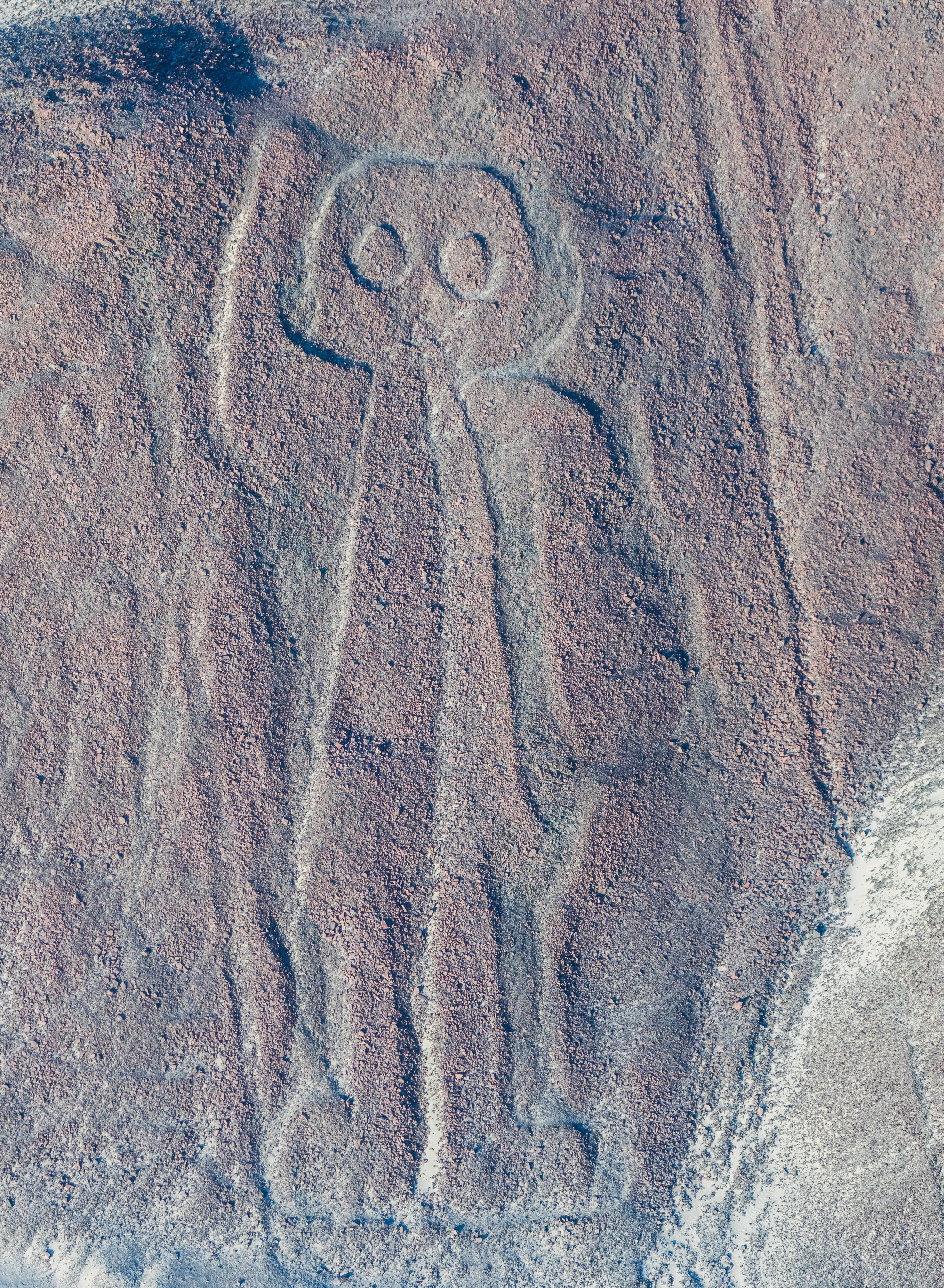
The Owlman, Nazca Lines
Diego Delso, delso.photo, License CC-BY-SA
This interpretation is supported by the arm gestures of the Owlman figure. The Q’ero are an indigenous community believed directly descended from the Incans, living a relatively isolated existence in the Peruvian Andes. With one arm in the air and the other facing towards the earth, this Owlman figure is reminiscent of the pose adopted in the following extract from the ‘four directions’ invocation used by Q’ero shamans:
Place one palm on the earth and the other arm up
Mother Earth – Pachamama
I pray for your healing
Let me soften into your wisdom
May I take great care of you so that my children and my children’s children
may witness the beauty and abundance you offer me today
In his paper, Edgar draws attention to the belief by numerous pre-Columbian cultures that the celestial jaguar god devoured the sun and moon during their respective eclipses. We believe this also to be consistent with our thesis of shamans having “eyes” with supernatural vision to “see in the dark”. For cats see well in the dark and jaguars are covered in spots that look like eyes. Marianne has suggested that jaguars’ spots may well be symbolic of the stars themselves in the night sky, each star an eye/[“I”]. As eyes are the windows to the soul, a shaman could commune with these eyes’/[“I”s’] souls and they did so through their own celestial soul which is symbolised by the middle eye in the “power” figure. Indeed, shamans in many cultures (including ancient Egypt) associated themselves with spotted animals – and Marianne suggests most likely because they were able to ‘see in the dark’ and read many eyes’/[“I”s’] souls/stars.
It is therefore our view that during the unusual cosmic environments and energies of these eclipses the shamans were receiving insights from their gods, “downloads” of spiritual law and understanding that they then sought to reflect in their geoglyphs. These “downloads” were messages for a collective audience, visions and illustrations of right-living and the consequences of wrong-living. For us, the geoglyphs produced from such events are likely therefore to be instructional in nature, intended to pass on messages of spiritual law and understanding. A significant parallel can be drawn here with certain Australian Indigenous practices. It is well known that the larger Nazca geoglyphs appear to be designed to be seen best from above. The Indigenous peoples of the Australian central and western desert region are internationally renowned for their artwork, commonly identified as Papunya. Their style is “figurative”, often using a dotted matrix form, together with elements such as lines, circles and spirals, to depict their country and their Dreaming stories as if seen from above. Christine Nicholls has observed that this practice “sometimes refers back to the old days when large ceremonial ground paintings, sculpted from coloured earths and sands, were dotted with clumps of animal down or the feathers of cockatoos or emus”. And in representing their Dreaming stories, the narratives that speak to their “worldview”, their land, religion and law, the artists may pass on directions, social and moral guidelines, about how to act in dealing with others and the surrounding natural world.
Visual messages
Of course, the Nazca lines and other geoglyphs are generally far more expansive, both in size and geography, than the artworks of the indigenous cultures of the Australian central and western desert. For some this suggests that their interpretation required viewing from above. Perhaps, but this is also clearly not true of many of the geoglyphs. The research team at Yamagata University had previously found various geoglyphs broadly clustered along different routes leading to a temple complex. While this has been thought to suggest that the complex was once a religious center where pilgrims would have brought offerings, the team also concluded that the geoglyphs lining those routes had been placed to be seen from these ritual pathways, and presumably therefore intended to be seen as part of the pilgrimage. Indeed, it is clear that the smaller “billboard” geoglyphs identified in the recent Japanese study were also clearly intended to be looked at from ground level. This contemplation could have taken place while walking along the paths beside which they were created, or in those cases where they were to be found on sloping inclines, the incline was likely intended to provide an opportunity for them to be more easily viewed.
Marianne suggests that the paths may well have been like “Pilgrim Ways”, with the geoglyphs’ instructive and thought provoking images designed to help pilgrims find their spiritual way. A study by two archaeologists, Clive Ruggles and Nicholas Saunders, would appear to provide some support for this possible interpretation. They identified one of the Nazca geoglyphs to be a labyrinth, and apparently intended itself to be walked, and given its physical integrity perhaps only occasionally, as for example they suggest by an initiate, pilgrim, shaman or victim. They conclude that its significance might lie “in metaphysical correlates associated with spiritual beliefs, rather than repeated use by humans”. In our view, the “billboard” geoglyphs identified in the Japanese study likely had a similar purpose. In a society without the written word, they may well have served in effect as a visual representation of spiritual law – a pictorial Bible if you will. And, just like the Bible, some of these images may have been prophetic whereas others might have been describing stories from the past or parables with a moral thread woven within them. Perhaps the geoglyphs formed part of what Lynne Kelly in her book, The Memory Code, has called in ancient cultures “a structured system for memorising vast amounts of rational information”, as “Australian Aboriginal songlines, Native American trails, Inca ceques [ritual pathways] and many other landscape paths created by indigenous cultures were the result of training their memories”.
Ruggles and Saunders suggest that the labyrinth they identified, its overall design asymmetric and unaesthetic to a Western eye, may well be an analogue for the wider Nazca pampa “where many straight lines and geometrical features that are not visibly associated from one location are nonetheless ultimately recognised as being connected as one moves along or around them”. As they recognise, their labyrinth may be merely “a microcosm of a larger organising principle similarly ‘hidden’ on the wider pampa, and whose conceptual significance emerges only from a combination of prior ritual knowledge, styles of movement and glimpses of intervisibility”. The fact that we find the geoglyphs so difficult to decipher is because they reflect the different time and cultural context in which they were formulated. They were also encoded in the symbolic language used by shaman and, as such, if you asked an Andean priest what they mean, you might gain greater insights into their meanings!
Whether as part of a “Memory Code” and/or a “Pilgrim Way”, or something else again, we believe that one purpose of at least some of the geoglyphs may have been instructional, to provide guidance and understanding of spiritual law and proper human behaviour.
Interpreting the purpose and meaning of any particular geoglyph involves deconstructing the figure. The process of deconstruction allows us to better understand the symbolism that has been used, which in turn enables us to attempt to determine the specific spiritual or other message intended. Which brings us to the focus of this paper, of the meaning of the AI-identified humanoid?
A “warrior”?
Clearly, at the most obvious level of interpretation, the figure appears to be brandishing a “club” in its right hand, an apparent image of a “warrior”. Given the early dating attributed to this geoglyph, this interpretation is consistent with the observation by Proulx that representations of warriors in early Nazca ceramic art are also nearly always depicted in a frontal, full-face manner holding weapons such as clubs in their hands.
But a figure brandishing a club may equally be understood more generically as a symbolic expression of domination, through the exercise of power, of which warfare or conflict is but a particular application. We consider that the “club” in this case may well represent such domination, and the “warrior” more properly then to be understood as a “power” figure.
Sun/moon duality
In the context of our discussion of the role of eclipses in the creation of these geoglyphs we noted that many ancient cultures considered the sun and moon to be sky dwelling gods. In South America, the later Incan civilisation is known to have seen the universe as a duality, with the sun as masculine and the moon feminine. Edgar has suggested that the Nazca geoglyphs show a similar spiritual understanding.
We find in the “power” figure a reflection of this spiritual sun and moon duality. We believe that the right side of the figure is represented as embodying his masculine energies, boasting a strong right arm wielding a club. His left side by comparison, embodying his feminine energies, is diminished – the eye drawn furthest to the left is the smallest, so too the extrusion rising above the head on the far left side, the left arm completely absent (although possibly merely later lost through damage to the image) and the left leg withered. The representation appears to focus on the strengths of his masculine energies, recognising the feminine side of his nature to be conversely withered and out of balance with his masculine energies. As represented, it is clear that in this imbalance, while his strengths as a figure of domination are emphasised, it is difficult for him to move forward in a balanced manner because of his neglected feminine qualities.
The feathers
We also believe that this symbolism is continued in the three protrusions extending above the figure’s head. They are likely to be feathers, as wearing a feathered headdress was certainly a feature of the later Incan monarchs (as, for example, the Statue of Pachacutec in Machu Picchu).

Statue of Pachacutec in Machu Picchu
Photo by Adrian Dascal on Unsplash
Feathers in shamanic tradition are symbolic of the soul’s journey to and from the spirit world just as birds are regarded as spiritual messengers. Similarly it is often said that the eyes are the windows of the soul – a portal through which the soul may travel. As such, the symbolism of a feather above each eye may well symbolise soul communication to an aspect of the divine in Andean cosmology.
In addition, given that each feather differs noticeably in its breadth, it is likely that the overall size of each feather is an indication of the strength of the type of ‘vision’ symbolised by the corresponding eye. Hence, the right eye would have connected to the masculine sun god (‘Inti’ in Incan cosmology). The sun god was likely associated with characteristics of the left hemisphere of the brain, ie. logic, reason and language – all characteristics of the divine masculine. It is noteworthy that this is the broadest feather and so it is reasonable to assume these were the strongest aspects of the culture that the figure represents, and as is reinforced in the other elements of the figure, at least of that period. The central feather likely symbolised a connection to the supreme god of the Andean pantheon Wira-qochan (“world teacher” and creator god) through the pineal gland or “third eye” (which appears to be represented immediately below it). This is the second broadest feather, which suggests their spiritual connection to the ‘world teacher’ was weaker than their connection to the divine masculine but stronger than their connection to the divine feminine. The eye on the left would have connected to the feminine moon god (‘Killa’ in Incan cosmology) – the right hemisphere of the brain – symbolising the creative, artistic and non-linear thinking of the right hemisphere of the brain – all divine feminine characteristics. The left feather is the smallest, meaning these feminine characteristics were weakest, as is also reinforced in the other elements of the figure.
The Third Eye
We have already drawn attention to what we believe to be a representation in the “power” figure’s head of a third eye. The third eye is well known as representing a gateway to higher consciousness, towards a state of enlightenment. It has not traditionally been recognised as amongst the beliefs of ancient New World civilisations, although the North American Hopi mythology refers to the “opening of the doors in their heads” which is certainly suggestive of the third eye. Moreover, Richard Cassaro has compiled an extensive collection of representations of such symbolism, including from Incan and pre-Incan cultures in South America. We believe that the “power” figure provides another example of this symbolism, and in the Nazca culture.
The womb
In considering the figure’s eyes, it is also to be noted that the left and right eyes are both round, with the larger on the right arguably representing the masculine sun god, the smaller on the left the feminine moon goddess. The central eye (third eye), on the other hand, is oval shaped, a symbolism similarly reflected in a 16th century drawing of the altar of Qorikancha, the most important temple in the later Incan civilisation, in which Wira-qochan (the Incan creator god) is represented as an oval, representative of the womb of all creation. In the drawing, Wira-qochan is positioned between its first two creations – the sun to their right and the moon to their left – the divine masculine and feminine gods. Wira-qochan is also positioned above both of its creations, signifying its genderless nature (it is beyond gender) and its role as the creatorix of both. The oval shape is significant in that it is the shape of a womb – the womb of all creation – for the “world teacher” is the creator. The terraces of Moray in Peru are also oval shaped – embodying the same creative principle.
Marianne has pointed to the fact that this is actually a principle that also finds its expression in modern science today – the field of quantum potential – a central concept in quantum mechanics. Yet we find representations of the concept not only in Incan tradition but also in various other ancient traditions. Other ancient deities that appears to represent the same concept of quantum potentiality include the Egyptian goddess Isis, the Greek goddesses Sophia and Artemis, and the Roman goddess Diana.
The figure’s northerly orientation
We consider that the direction that the figure is facing may also well be significant in deconstructing its meaning. It is clearly northerly facing. We have already referred to the ‘four directions’ invocation used by Q’ero shamans. In that invocation, the shamans invoke the North in the following terms:
Face the north with one arm up and the other palm open to receive
To the Winds of the North
Royal Hummingbird
Ancient Ones
Teach me about your endurance and your great joy
Come to me in the dreamtime
With honor I greet you
In this invocation, the North is represented by the Royal Hummingbird and ancient ones, which are called upon to come to the speaker in the ‘dreamtime’. Marianne suggests that the reference to the Royal Hummingbird may well be to “the eternal”, for the hummingbird’s wings beat in the shape of the symbol for eternity. The Ancient ones is probably a reference to the ancient gods of the Andean pantheon, just as Indigenous Australians refer to communing with the ancient ancestor beings that shaped the formation of the world. In today’s vernacular, this might be described as communing with the forces of nature. And given that the dreamtime is the state of communion with the spirit world, it is surely no coincidence in this invocation that in Andean cosmology the hummingbird represents the highest level of spirituality.
We believe that it may well be that in the figure’s orientation, there is an implication that the source or inspiration for this image has come from the ancient eternal ones – the gods of the heavens – through a dreamtime experience (trance like state in which shamans access the spirit world).
The head
We also believe that while the figure was created by the Nazca, it was related to a neighbouring culture, the Tiwanaku (sometime contemporaries of the Nazca). The Tiwinaku capital became one of the Andes’ most important pilgrimage destinations and their influence is known to have extended into the Peruvian Moquegua Valley, establishing an agricultural and mining colony there from around 400CE. The Tiwanaku were noted stonemasons and amongst the ruins of the capital is the “Gate of the Sun”, a solid stone structure some 3 metres high and 4 metres wide that some scholars suggest may be 14,000 years old.

Gate of the Sun in Tiwanaku
By Mhwater – Transfered from nl.wikipedia, Public Domain, Link
To us, the blocklike form of the “power” figure’s head is very reminiscent of the Gate of the Sun. Indeed, we consider that the allusion is so strong that this may have been intended to be a direct reference to the Tiwanaku culture. We believe this view is supported by the nature of the Tiwanaku state. Mathew Bandy has suggested that the Tiwanaku culture was a multicultural “hospitality” state, in which high status individuals – the elite – engaged in acts of hospitality which served to emphasise institutionalised social inequality. Their society was one also that established a widespread hegemonic cultural dominance, not through traditional militaristic means as such, but through immigration and colonial expansion (including into present day Peru). In this process they subordinated other cultures within the region, with significant social inequality.
We believe that it is to this hegemonic cultural dominance that the “power” figure is directed. However, we believe that dominance is merely the visible expression of an underlying spiritual imbalance in the culture. Indeed, it is interesting that given in the later Incan culture the sun god was a masculine deity, even the terminology of the so-named “Gate of the Sun” is perhaps suggestive of a modern implication of imbalance in the Tiwinaku culture – towards the masculine.
In our interpretation the figure was created by Nasca shamans, under the direction of their spirit guides, to reflect the need for energetic balance, a spiritual principle relating to the need for balance between divine masculine and feminine qualities using their neighbouring culture, the Tiwanaku, as a negative example. In this paper we have attempted to deconstruct the image in identifying those insights. We believe they reveal the intention to portray the Tiwanaku as an aggressive, hegemonic culture of domination (not in the traditional militaristic sense, but in using the representation of a club in the figure to embody their cultural subordination of those who came within their influence) with advanced stonemasonry skills, a moderate spiritual understanding but with meagre creativity, empathy, nurturing and emotional sensibilities. And given we believe these insights to be instructional in nature, we see starkly emphasised in the figure a message of spiritual imbalance, between masculine and feminine energies.
Whilst it is not known for sure what caused the fall of the Tiwanaku Empire, it has been suggested that it was its sociodynamics. There is evidence to suggest it was the result of a social upheaval; possibly even a revolt over the control of food supplies by the ruling elite. Perhaps it is an appropriate symbolism that the Gate of the Sun, when rediscovered by Europeans a millenia after the fall of the Tiwanaku Empire, was found knocked over with a large crack through it.
In developing this thesis, we note that we have not sought to focus upon current views as to timelines in the formation and development of the Tiwinaku culture. The early history of the culture does not appear to have received as much archaeological attention as the later Empire and we believe that in furthering our understanding of the Tiwinaku culture at the time of the creation of the “power” figure it is appropriate to let the deconstruction of the Nazca figure speak its message
The rediscovery of this NAZCA “power” figure is a timely reminder of the work our culture needs to undertake if it is to survive and move forward in a balanced manner. The emphasis here is on the word ‘survive’ for we need look no further than the Incan, Aztec or even Roman cultures to determine what happens to cultures that express extreme masculine qualities that lead to ruthless exploitation and expansionism. Having a level of spiritual understanding was clearly not enough to save these cultures, as each had a system of spiritual beliefs which comprised a pantheon of masculine and feminine energies (i.e. Gods and Goddesses). In the case of the Incans at least, their cosmology even espoused the importance of maintaining a balance between these energies in order to retain the goodwill of the gods. So what went wrong? One explanation may be that the feminine qualities of collaboration, emotional intelligence, nurturing, care for the vulnerable and non-linear thinking held insufficient appeal when compared with the allure of riches and power sought by the Incan elite. The consequences of this lack of balance appear to have been the destruction of this seemingly invincible South American empire by the even more powerful and ruthless Spanish invaders. The once mighty Incans became the impoverished servants of their new Spanish rulers.
It should also be pointed out that the need for nurturing, care and balance extends beyond people, to the environment. It is surely no coincidence that feminine energies have traditionally been associated with Mother Earth. Somewhat ironically, the demise of the Nazca culture appears likely due to the over exploitation of the natural environment. Archaeologists postulate that the Nazca culture was destroyed by flooding caused by the combined effects of an El Niño and a landscape that had been cleared of trees for agricultural purposes.
Our own patriarchal Western society lies in similar imbalance, with growing calls for greater emphasis in our community upon the feminine – upon the qualities of collaboration, emotional intelligence, nurturing and care for the vulnerable – qualities that in greater prominence may just save our Western society from a similar demise to the Tiwanaku. Western culture would be well advised to take heed of the warning represented by this new Nazca “power” figure, lest we suffer the same type of karmic ‘rebalancing’ events that were triggered by the actions of the Incan, Nasca and possibly Tiwanaku cultures. For if we don’t choose to take the necessary steps to address the imbalances in our society, and the environment in which we live, fate will surely step in and do the job for us.
—————————————————
References
All internet references are as accessed on 22 December 2019.
Anon, Gaia: How to Hold a Four Directions Ceremony (3 February 2017) (https://www.gaia.com/article/four-directions-ceremony)
Bandy, M., “Tiwinaku Origins and Early Development: The Political and Moral Economy of a Hospitality State” in Vranich, A and Stanish, C. (eds), Visions of Tiwinaku (Los Angeles, Cotsen Institute of Archaeology, 2103) at 135-150 (https://www.academia.edu/24665779/Tiwanaku_Origins_and_Early_Development_The_Political_and_Moral_Economy_of_a_Hospitality_State)
Cassaro, R., Discovery Of The Third Eye In The Ancient Americas (18 November 2015) (https://www.richardcassaro.com/discovery-of-the-third-eye-in-the-ancient-americas/)
Coghlan, A., Clearing oasis trees felled ancient Peru civilisation (2 November 2009) (https://www.newscientist.com/article/dn18091-clearing-oasis-trees-felled-ancient-peru-civilisation/)
Eda, M et al, “Identifying the bird figures of the Nasca pampas: An ornithological perspective” (2019) 26 Journal of Archaeological Science: Reports 101875 (https://doi.org/10.1016/j.jasrep.2019.101875)
Edgar, R., The Nazca Lines and “The Eye In Sky”: How Total Solar Eclipses Inspired the Nazca Lines & Geoglyphs (2000) (https://www.bibliotecapleyades.net/nazca/esp_lineas_nazca_16.htm)
Garces, E., The Inka Astronomy Handbook (First English edition March 2018) ISBN: 978-612-00-3214-5
Ghose, T., : “Mysterious Nazca Line Geoglyphs Formed Ancient Pilgrimage Route” (1 May 2015) Livescience (https://www.livescience.com/50699-nasca-lines-ritual-procession.html)
History.com Editors, “Nazca Lines” (21 August 2018) History (https://www.history.com/topics/south-america/nazca-lines)
Kelly, L., The Memory Code (Allen & Unwin, 2016)
Nicholls, C., Art, History, Place (Working Title Press, Kingswood SA, 2003)
Proulx, D., The Nasca Culture: An Introduction (1999, 2007) (https://people.umass.edu/~proulx/online_pubs/Nasca_Overview_Zurich.pdf)
Ruggles, C., & Saunders, N., “Desert labyrinth: lines, landscape and meaning at Nazca, Peru” (2012) 86(334) Antiquity 1126–1140
Smithfield, B., The Vintage News: The Gate of the Sun: A megalithic solid stone structure, confusing experts ever since its discovery (19 April 2017) (https://www.thevintagenews.com/2017/04/19/the-gate-of-the-sun-a-megalithic-solid-stone-structure-confusing-experts-ever-since-its-discovery/)
Whelan, E., “AI Identifies New Geoglyphs Among Nazca Lines in Peru” (19 November 2019) Ancient Origins (https://www.a ncient-origins.net/news-history-archaeology/nazca-lines-geoglyphs-0012881)
Wikipedia contributors, “Creation of man from clay” Wikipedia, The Free Encyclopedia (https://en.wikipedia.org/w/index.php?title=Creation_of_man_from_clay&oldid=926688231)
Wikipedia contributors, “Gate of the Sun” Wikipedia, The Free Encyclopedia (https://en.wikipedia.org/w/index.php?title=Gate_of_the_Sun&oldid=912651337)
Wikipedia contributors, “Nazca culture” Wikipedia, The Free Encyclopedia (https://en.m.wikipedia.org/wiki/Nazca_culture#)
Wikipedia contributors, “Nazca Lines” Wikipedia, The Free Encyclopedia (https://en.wikipedia.org/w/index.php?title=Nazca_Lines&oldid=931584504 )
Wikipedia contributors, “Tiwanaku empire” Wikipedia, The Free Encyclopedia (https://en.wikipedia.org/w/index.php?title=Tiwanaku_empire&oldid=930671787)
Yamagata University and IBM Japan, Press Release: 143 New Geoglyphs Discovered on the Nasca Pampa and Surrounding Area (15 November 2019) (https://www.yamagata-u.ac.jp/en/files/7615/7381/2393/PRESS_RELEASE_nasca191115EN.pdf) (also see https://www.yamagata-u.ac.jp/en/information/info/20191115_01/)